Curse of Aquafa
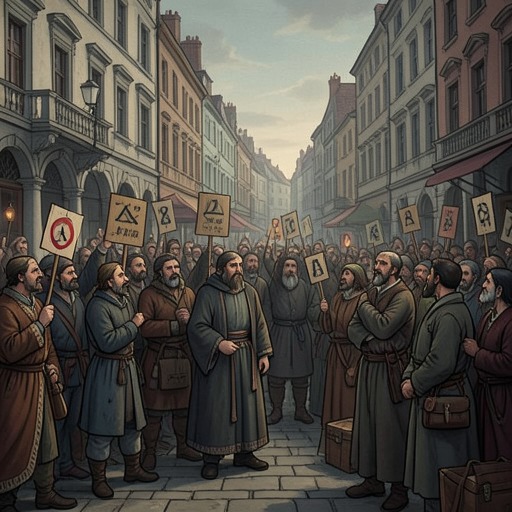
The Deer KingThe Curse of Aquafa is the name given to a spreading belief that a disease associated with dog bites is divine retribution against Zol for its conquest of Aquafa. The rumor turns a pattern of illness and death into a moral verdict: the invaders have defiled the land, and its gods are striking back. It becomes more than an explanation for disease. It gathers historical grievance, disputed evidence, and fear into a story that can shape how communities understand the dead—and how they respond to the living threat.
Origins in Conquest and Unequal Status
The rumor draws force from a history in which Zol's incorporation of Aquafa did not bring equal treatment to every people under imperial rule. Aquafa secured provincial status and its inhabitants ordinary citizenship by aligning with the conquerors. The mountain clans of Toga, by contrast, were not recognized as Aquafaese citizens, despite sharing their language and having defended the kingdom's borders. Zol's frontier policy could require lower-status populations to leave their homes and resettle elsewhere; facing that prospect, the Gansa elders considered a show of resistance as a way to bargain for more tolerable terms. Imperial rule had therefore made questions of land and belonging immediate long before anyone called the disease a curse. This history has material consequences in the household of Ohma, Kiya, and Tohma. Kiya's family had emigrated from the northern outskirts of Zol, and both families had become close through mutual aid, but they remained poor. Ohma's attempt to replace some taxed reindeer with pyuika failed for lack of breeding knowledge, leaving the family near disaster. The distinction between imperial identity and local identity also appears in Kiya's account of the Pure Heart Creed: followers believe that drinking animal milk defiles a person, but her people, absorbed into the empire rather than raised in the Creed, had long lived on reindeer milk. Such differences help explain why illness could be interpreted through categories of conqueror and conquered, faithful and supposedly defiled, rather than as a danger shared across those divisions.
How the Rumor Takes Hold
The belief circulates as reports from multiple places and episodes accumulate. Tohma tells Van that people bitten by dogs have died in settlements on the Yukata Plains and south of the Oki Valley, and that immigrants have also been among the dead. He connects those reports with the attack at the royal falcon hunt: according to the account he has heard, Utalu and some Zolian women died after black dogs attacked, while the king's relatives survived. The contrast appears to support the rumor that Zolians are singled out, even though it cannot establish that ancestry or political identity determines who lives. The survival of Olimu, Yotalu's eldest son, becomes another piece of supposed proof. The rumor explains his survival by saying that his mother was the King of Aquafa's niece and that Aquafaese blood runs in him. Tohma contrasts this with Utalu, who had looked down on the local people and died. A complex and still uncertain pattern is thus compressed into a legible moral division: the imperial outsider dies, while someone partly connected to Aquafa survives. Hohsalle's later account complicates that inference. Olimu's symptoms were less serious than those of Izam, who was half Zolian; without Limuelle's drastic treatment, Hohsalle says, Izam would likely have died. The cases do not establish immunity by ancestry. The salt mine supplies the rumor with a founding scene. Tohma recalls that its enslaved workers died around the time he and Van first met. In the account circulating among the people, the mine had been sacred, a gift from the gods of Aquafa, before Zol turned it into a place of forced labor. The disease's appearance there is consequently cast as punishment for the desecration, with the Hounds of the Gods said to have struck first at the violated site. Tohma even wonders whether the pack he saw in the forest might have been those supernatural agents. The account connects a specific history of imperial violence to later deaths, making a difficult-to-verify disease pattern seem like a deliberate judgment.
Contested Evidence and Medical Risk
In Kazan, the rumor reaches Governor Ohan after he has lost his eldest son, and its claims acquire political urgency. Asked whether the Aquafaese cannot die of the disease, Hohsalle refuses to endorse either certainty or a supernatural cause. The previous recorded outbreak was nearly 250 years earlier; the present symptoms resemble the historical accounts, but that resemblance does not prove that the illness is the same. Nor is there proof that Aquafaese are immune. The only deaths observed so far have been Zolian, but the difference in severity between Izam and Olimu argues against a simple division between populations. Hohsalle's concern is that the rumor could make people less wary of the animals associated with the disease. If Aquafaese believe they cannot be affected, they may take fewer precautions, increasing exposure. He also warns that if the illness shares the characteristics of historical black wolf fever, its means of transmission might change: as warm weather brings more fleas and ticks, insects feeding on infected humans and animals could potentially spread it. He treats that possibility as a risk, not a confirmed development. The curse story is dangerous precisely because it can turn a contested pattern of deaths into reassurance for those who believe themselves exempt. The possibility of treatment introduces a further conflict. Hohsalle argues that Aquafaese who lack resistance can also die, but that continued development of medicine made from weakened disease agents could save them. If Zolians cannot be inoculated because their religious commitments forbid introducing animal-derived medicine, the disease could in practice kill only Zolians. That outcome might then appear to confirm the curse, although it would arise from unequal access to prevention rather than proof of divine selection. Hohsalle's warning links interpretation to consequence: a rumor can become more convincing as a result of the choices made in response to it.
Belief, Memory, and Political Meaning
The rumor is not confined to village talk. Hohsalle is surprised when his sister Luliya asks him to explain the Curse of Aquafa: Moiya has mentioned it, and so has her husband, Tomasolle, whom Hohsalle had regarded as someone inclined to dismiss curses. Tomasolle has nevertheless said seriously that the claim should not be taken lightly. The report shows the story crossing social circles that Hohsalle expected to remain skeptical; uncertainty itself has become part of the crisis. Nor is the rumor solely a mistaken account of infection. For people who remember conquest, forced relocation, and the salt mine, it gives political meaning to deaths that disproportionately appear to fall on Zolians, including immigrants and enslaved people brought from the east. Makokan recognizes that Aquafa and Otawalle may have little reason to help the Zolian authorities capture anyone suspected of using the disease for revenge, particularly when the victims are chiefly Zolian. This does not prove that a human actor caused the disease or that the rumor is true. It reveals how the idea can make vengeance seem intelligible, and how imperial power determines whose deaths are treated as an urgent public concern. Van rejects the supernatural claim, remembering that people in his homeland had attributed persistent coughs to offending a tree's god and intestinal illness to defiling a river. He sees such explanations as ways people impose familiar meaning on sickness, and he believes that people use the divine to support what they already want to think. Yet the rumor's persistence is not reducible to credulity: it draws on real inequalities, real deaths, and the unresolved question of what happened at the salt mine and the falcon hunt. The narrative leaves the curse unverified while showing its force plainly. It can distort judgments about immunity, complicate disease prevention, and turn the consequences of conquest into a claim of divine justice.